February 3, 2026
Nature out of sync: Why “fast adaptation” is a dangerous myth
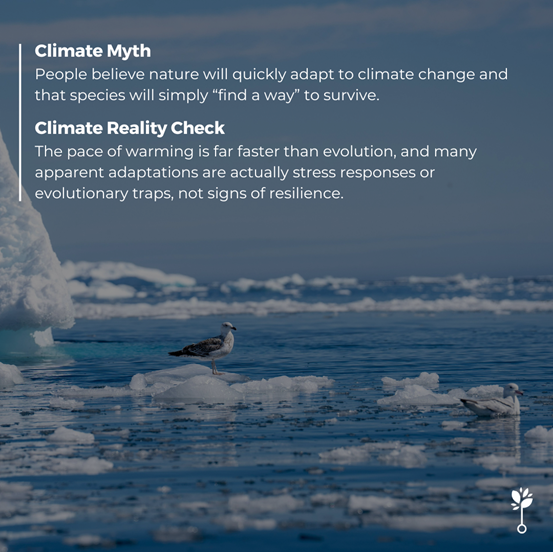
We often hear that nature is incredibly resilient and that animals will simply “find a way” to survive as the world warms. While it’s true that some species are changing their behaviors, like birds arriving earlier in the spring, scientists are finding that these shifts aren’t happening fast enough. In many cases, these changes are actually “evolutionary traps” that look like survival strategies but might lead to disaster.
The reality is that today’s climate change is moving faster than at any point in the planet’s recent history[1]. While animals can be flexible in their lifetimes, true evolution (changing their DNA over generations) takes much longer.
The problem of nature’s broken clock
One of the biggest issues is that different parts of nature are falling out of sync. This is called “phenological mismatch”[2]. Imagine a bird that migration-times its arrival to when caterpillars are most plentiful. If the caterpillars hatch earlier because of a warm spring, but the bird still follows the “clock” of day length to start its journey, it arrives too late to find enough food for its chicks.
Real-world examples of the “mismatch”
- The snowshoe hare: These hares turn white in winter to hide in the snow. But as spring arrives earlier, they are often left standing out as bright white dots against a brown, snowless background, making them easy targets for predators[3].
- Arctic shorebirds: Earlier snowmelts trigger insects to emerge sooner. Birds like the Dunlin are struggling to hatch their chicks in time to catch that “bug peak,” leaving their young with unpredictable food supplies[4].
- Tree swallows: These birds are laying eggs up to nine days earlier than they used to. While this sounds like a win, it’s a gamble: one sudden cold snap after an early arrival can wipe out an entire generation[5].
Nature’s gender-flipping thermostat
For some species, the heat does something much weirder: it changes whether babies are born male or female.
In green sea turtles, the temperature of the sand determines the sex of the hatchlings. Cooler sand produces males; warmer sand produces females[6]. On Australia’s northern Great Barrier Reef, the sand has become so hot that nearly 99% of juvenile turtles are now female[7]. Without enough males to fertilize eggs in the future, these populations face a “silent extinction” where they simply stop reproducing.
Bizarre behavioral shifts
Animals are getting “creative” to survive, but it often comes with a high price tag.
- Moonlight & wild dogs: African wild dogs usually hunt at dawn and dusk to avoid the heat. To stay cool, they’ve tried hunting more at night. However, they can only see to hunt when the moon is bright. Since the moon doesn’t change with the climate, there’s a limit to how much they can adapt. When raising pups, they often can’t hunt enough at night to keep up, leading to higher pup mortality[8].
- The “Pizzly” bear: As Arctic ice continues to retreat due to rising global temperatures, polar bears are increasingly moving south in search of food, while grizzly bears are expanding their range northward into formerly colder regions. This overlap has led to interbreeding between the two species, resulting in hybrid animals known as “pizzly” or “grolar” bears[9]. While these hybrids demonstrate the adaptability of wildlife to changing environments, they are generally less specialized than their parent species. Pizzly bears tend to be less effective at hunting on sea ice than polar bears and less efficient at terrestrial foraging than grizzlies, making them ecological generalists rather than specialists, an outcome that may reduce their long-term survival prospects in a rapidly changing climate.
- Storks & junk food: Many White Storks are skipping their 16 500 km migration to Africa. Instead, they’ve become year-round residents in Turkey and North Africa, living on mosque domes and eating trash from landfills. It saves energy, but we don’t yet know the long-term health effects of a “garbage diet”[10].
Closer to home: A shifting European landscape
Across Europe, especially in Central and Southeastern regions, ecosystems are undergoing a quiet but profound “Mediterranean transformation”. Insects adapted to warmer climates are spreading northward, while species that rely on cool, wet conditions are steadily declining.[11]
- Invasive influx: In the last 25 years, nearly 300 new insect species have arrived in Central Europe, with over half coming from tropical or Mediterranean regions[12]. This includes mosquitoes that carry diseases once rare in this region.
- Carpathian bottleneck: Many cold-adapted plant species in Europe’s lower and mid-altitude mountain ranges are becoming increasingly vulnerable. As temperatures rise, plants typically move upslope to find cooler conditions, but the Carpathians are relatively low, mostly below 2,500 meters, which limits this natural adaptation pathway. As a result, cold-adapted species are pushed toward mountain summits, where suitable habitat rapidly disappears[13]. Once they reach the top, they effectively “run out of mountain,” increasing the risk of local extinction as warming continues.
- Fading moss: Mosses and other moisture-dependent species are also under pressure. Protected peatland mosses across Europe are threatened as rising temperatures and prolonged droughts dry out the cool, water-rich habitats they depend on. By the end of the century, scientists estimate it could lose up to 60% of its habitat, putting its long-term survival at risk[14].
The Domino effect: Keystone species
When one important species changes, it can collapse the entire system. These are called Keystone Species -like the top stone in an arch that holds everything together.
- Sea otters & kelp: In the Pacific, sea otters eat sea urchins. When otter numbers drop, urchin populations explode and eat all the kelp. This turns a lush underwater forest into a “desert” of urchins, leaving hundreds of other species homeless[15].
- Wolves & rivers: In Yellowstone, the return of wolves controlled the elk population. This allowed willow trees to grow back, which gave beavers wood to build dams. Those dams created wetlands for fish and birds. Removing the wolves originally “broke” the river’s entire ecosystem[16].
Conclusion: A warning signal
The “unusual” behaviors we see today, from bears hybridizing to storks eating garbage, are not signs that nature is “winning” against climate change. They are stress signals. While life is trying to adapt, the pace of our warming world is currently winning the race. Protecting these species requires more than just watching them change; it requires us to slow down the warming before their “resilience” runs out.
[1] https://science.nasa.gov/climate-change/evidence/
[2] https://www.nature.com/articles/s41559-025-02679-7
[3]https://www.ehn.org/impact-of-climate-change-on-wildlife#:~:text=Between%2085%20and%20100%20percent%20of%20snowshoe,predators%2C%20hares%20stay%20completely%20still%2C%20refusing%20to
[4] https://www.audubon.org/magazine/matter-timing-can-birds-keep-earlier-and-earlier-springs
[5] https://www.pnas.org/doi/10.1073/pnas.2009864117
[6]https://www.seaturtlestatus.org/articles/how-temperature-determines-sex-in-sea-turtles#:~:text=The%20result%20is%20that%20warmer%20incubations%20create,spraying%20them%20with%20water%20and%20shading%20them.
[7] https://wwf.panda.org/wwf_news/?320295/90%2Dpercent%2Dfemale%2Dturtles
[8]https://theconversation.com/climate-change-is-causing-endangered-african-wild-dogs-to-give-birth-later-threatening-the-survival-of-the-pack-189337
[9] https://greatergood.com/blogs/news/grolar-bears-climate-change
[10] https://www.audubon.org/news/storks-are-skipping-migration-stay-home-and-eat-garbage
[11] https://www.mdpi.com/2673-4133/6/1/16
[12] https://www.mdpi.com/2673-4133/6/1/16
[13]https://journals.openedition.org/rga/15265#:~:text=R%C3%A9sum%C3%A9%20This%20study%20deals%20with%20the%20climate,the%20upward%20migration%20of%20the%20plant%20communities.
[14]https://pmc.ncbi.nlm.nih.gov/articles/PMC12609563/#:~:text=Despite%20its%20protected%20status%2C%20the,pH%20of%205.0%E2%80%937.5%20H.
[15]https://defenders.org/wildlife/sea-otter#:~:text=As%20top%20predators%2C%20sea%20otters,food%20for%20other%20marine%20animals.
[16]https://www.theguardian.com/environment/2022/jun/23/rebalancing-act-bringing-back-wolf-fix-broken-ecosystem-aoe#:~:text=The%20number%20of%20elk%20in,aspen%2C%20allowing%20them%20to%20flourish.
Other News