
April 20, 2026
Climate myth debunked: why agriculture, not industry, is killing our forests
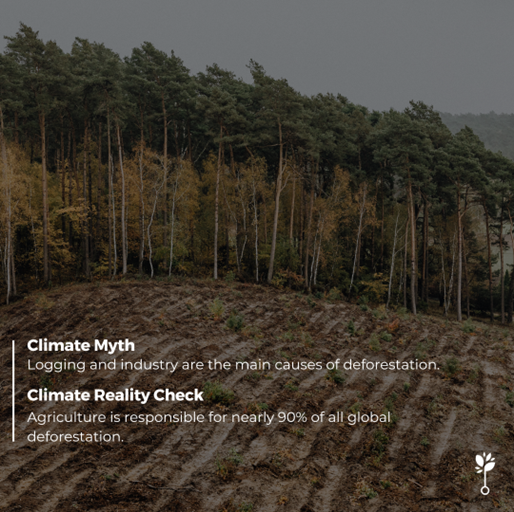
When we think of deforestation, most of us imagine giant logging trucks carrying away timber or factories puffing smoke where a forest used to be. It feels natural to blame the paper and furniture industries for the loss of our trees.
However, this is a major climate myth. While logging and industry do cause damage, they are not the main reason forests are disappearing forever. The real “forest killer” is something much closer to home: our global food system.
The Myth: Logging and industry are the main causes of deforestation.
The Reality: Modern research shows that agriculture is responsible for nearly 90% (88%) of all global deforestation.
As of 2025, forests cover approximately 4.14 billion hectares, roughly one-third of the Earth’s land surface[1]. However, the global community remains significantly off track from the goal of halting forest loss by 2030, with deforestation rates in 2024 remaining 63% higher than the levels required to meet that target.
| Driver | Primary Impact | Contribution (%) |
| Agriculture | Permanent land conversion | 88% – 90% |
| Logging & Timber | Mostly forest thinning (degradation) | ~5% – 10% |
| Urban Development | Permanent land conversion | <5% |
| Wildfires | Variable loss/damage | Increasing |
Agriculture vs. industry
Research indicates that agriculture is responsible for approximately 88% to 90% of all global deforestation[2]. In contrast, mining, the building of cities, and industrial infrastructure typically account for less than 5% each.
The primary mechanism for this loss is extensive agriculture. This occurs when producers clear “new” land in the forest rather than improving the yields of existing farms. In many tropical regions, the soil directly under a cleared forest is temporarily very fertile. Farmers exploit this “forest rent” until the soil is exhausted, at which point they move deeper into the forest to clear more land, leaving a trail of degraded territory behind.
Land use inefficiency: Livestock and the crops grown to feed them occupy 77% of all agricultural land on Earth. Despite using more than three-quarters of our farmland, this system provides only 18% of global calories and 37% of global protein[3][4].
The impact of beef: Cattle ranching is the single largest driver of forest loss. It is responsible for 41% of all tropical deforestation globally[5]. In the Amazon rainforest, cattle ranching accounts for between 72% and 80% of all cleared land[6].
The soy-feed connection: While many people associate soy with human food like tofu, 80% of the world’s soy is actually used as high-protein feed for livestock[7] (mainly poultry and pigs). Only about 6% of soy is eaten directly by humans.
Luxury commodities: cocoa and coffee
Beyond basic food and meat, “luxury” crops like cocoa and coffee put extreme pressure on high-biodiversity tropical regions.
Cocoa and the cycle of exhaustion
In West Africa, cocoa cultivation has driven over 60% of agricultural deforestation in major exporting countries like Côte d’Ivoire and Ghana since 2000[8]. Côte d’Ivoire has lost an estimated 94% of its forest cover since 1960, largely because farmers clear primary forest to capture the high initial soil fertility. Once the soil becomes poor, the farmers are forced to migrate further into the remaining forest.
Coffee’s shift to the sun
The transition from forest-friendly “shade-grown” coffee to “sun-grown” systems remains a critical threat. Sun-grown systems maximize short-term yields but require the total removal of forest cover.
- Brazilian footprint: As of 2025, coffee cultivation has punched a Honduras-sized patch in Brazilian forests. Between 2001 and 2023, approximately 1,200 square miles of forest were cleared directly for coffee[9].
- The climate paradox: By removing the forest canopy to increase yields, farmers have disrupted local rainfall patterns. This has led to severe droughts that devastated yields in 2024 and 2025, causing coffee prices to rise by over 40%[10].
- Regulatory delay: The European Union Deforestation Regulation (EUDR), intended to ban coffee from deforested land, was postponed in late 2025. Large operators now have until December 30, 2026 to comply. Critics estimate this delay has already resulted in the loss of an additional 190,000 hectares of forest[11].
Regional dynamics
The causes of forest loss vary by region but share a common agricultural root:
- The Amazon: Driven by large-scale cattle ranching and soy expansion. Land speculation, clearing forest simply to increase the value of real estate, is also a major factor[12].
- Southeast Asia: Primarily driven by palm oil. While rates in Indonesia and Malaysia have slowed, palm oil still accounts for a significant portion of peatland conversion[13].
- Congo Basin: Historically driven by small-scale farming and fuelwood, but now facing a surge in industrial cocoa and rubber clearing. In 2023, Cameroon saw its highest level of primary forest loss ever recorded[14].
- Wildfire spike: In 2024, for the first time, wildfires became the leading driver of tropical forest loss, often spreading from fires intentionally set to clear land for agriculture[15].
The data demonstrates that halting deforestation is not just about “protecting trees” from loggers; it requires a systemic change in how we use land for food. To meet the global goal of ending forest loss by 2030, the world must address three key areas:
- Reducing food waste: Over 30% of all food produced is currently wasted[16].
- Land restoration: There are up to 2 billion hectares of degraded land[17] that could be revived for farming, removing the need to cut down primary forests.
- Dietary efficiency: Shifting even partially toward plant-based diets reduces the total amount of land needed. Producing a single calorie of beef requires roughly 50 to 100 times more land than producing a calorie from plant-based sources[18].
[1]https://www.fao.org/newsroom/detail/global-deforestation-slows–but-forests-remain-under-pressure–fao-report-shows/en
[2]https://www.fao.org/newsroom/detail/cop26-agricultural-expansion-drives-almost-90-percent-of-global-deforestation/en
[3] https://www.weforum.org/stories/2019/12/agriculture-habitable-land/?
[4] https://ourworldindata.org/environmental-impacts-of-food
[5] https://earth.org/how-animal-agriculture-is-accelerating-global-deforestation/
[6]https://wwf.panda.org/discover/knowledge_hub/where_we_work/amazon/amazon_threats/unsustainable_cattle_ranching/
[7]https://earthworm.org/news-stories/le-soja-un-ingredient-du-quotidien-aux-enjeux-environnementaux-majeurs
[8]https://wwf.panda.org/es/?15675941/Business-as-usual-cocoa-Is-driving-a-new-wave-of-global-forest-destruction-warns-new-WWF-report
[9]https://www.upr.org/npr-news/2025-10-24/coffee-driven-deforestation-is-making-it-harder-to-grow-coffee-watchdog-group-says
[10]https://www.fao.org/newsroom/detail/adverse-climatic-conditions-drive-coffee-prices-to-highest-level-in-years/en
[11]https://brusselssignal.eu/2025/11/chocolate-and-coffee-production-at-risk-with-ec-deforestation-law-delay/
[12] https://scienceinsights.org/why-is-the-amazon-rainforest-being-destroyed/
[13] https://eos.com/blog/palm-oil-malaysia-indonesia-thailand/
[14] https://www.globalforestwatch.org/dashboards/country/CMR/
[15] https://www.wri.org/news/release-global-forest-loss-shatters-records-2024-fueled-massive-fires
[16] https://greenly.earth/en-gb/blog/industries/global-food-waste-in-2022
[17] https://www.unccd.int/land-and-life/sustainable-development-goals/overview
[18] https://ourworldindata.org/land-use-diets
Other News
