March 3, 2026
Climate myth: Carbon dioxide (CO₂) is a toxic gas that harms humans when we breathe it.
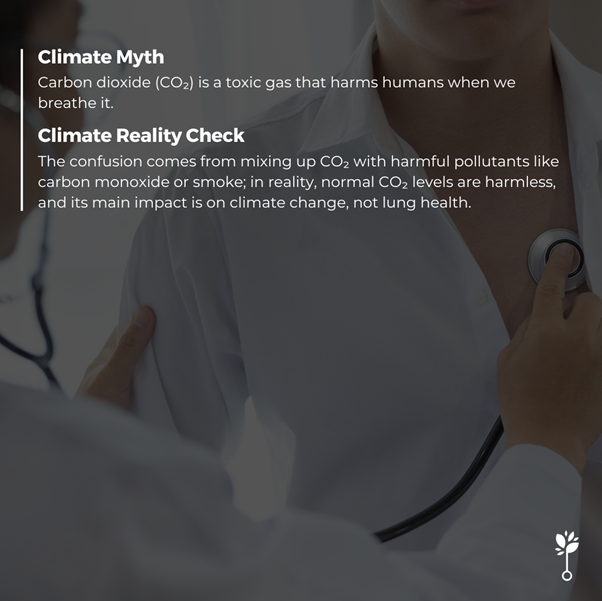
Carbon dioxide (CO₂) is a normal part of the air we breathe – about 0.04% (400 parts per million) of our atmosphere is CO₂[1]. We exhale CO₂ with every breath, and plants take it up to grow. At these levels, CO₂ is not poisonous or irritating[2]. In fact, CO₂ is so harmless that scientists point out it’s “a vital part of the environment”[3]. The misconception that CO₂ is toxic comes from confusing it with other air pollutants (like smoke, soot or toxic gases) or with carbon monoxide (CO), which is very dangerous. Unlike those pollutants, CO₂ has no smell or irritation effect at normal concentrations.
Natural background vs. pollutants
Air pollution that affects our health usually involves tiny particles (aerosols) or gases like carbon monoxide and nitrogen oxides[4], not CO₂. For example, carbon monoxide (CO) is deadly at just tens of parts per million, whereas CO₂ must reach thousands of ppm before it causes any acute harm. Similarly, aerosols (dust, soot, sulfates, etc.) can aggravate lungs and even partly cool the planet by reflecting sunlight[5], but CO₂ is just an invisible gas that warms the planet (see below). People often hear “emissions” and picture smog, but burning fuel produces both: fine particles that hurt lungs and CO₂ that affect climate. The misplaced worry is thinking of CO₂ itself as a lung poison.
CO₂ and our bodies
Humans and animals produce CO₂ naturally. Our breathing system actually relies on CO₂ in a feedback loop. We typically breathe out air that is ~4% CO₂, and breathe in air with only ~0.04%. This vast difference shows why common indoor levels (often 1,000–2,000 ppm in crowded rooms) might make people feel a bit sleepy or stuffy, but outdoors at 400 ppm CO₂ is imperceptible[6]. The bottom line is that normal CO₂ levels won’t hurt you, it’s only at very high concentrations that CO₂ starts to become dangerous.
High CO₂ as an asphyxiant
If CO₂ builds up to a few percent of the air, it begins to displace oxygen. In other words, CO₂ acts as an asphyxiant: it doesn’t chemically poison you, but it crowds out the oxygen your body needs. For example, exposure to around 1–2% CO₂ (10,000–20,000 ppm) can cause faster breathing and headache; around 5% CO₂ can induce confusion or unconsciousness[7]. Only at extremely high levels (above ~30–40% CO₂) does it cause rapid suffocation and death[8]. Luckily, such levels never occur outdoors, they might only happen accidentally in closed spaces (like deep mines or sealed tanks).
CO₂ vs. other air pollutants – Clearing the confusion
- Visible smog vs. invisible gas: Many people in cities equate “dirty air” with breathing hazards, and it’s easy to lump CO₂ in with that. But the usual culprits of smog are aerosols and toxic gases (e.g. black carbon, sulfates, ozone). These tiny particles and reactive chemicals irritate lungs and are linked to heart/lung disease[9].
- CO₂ vs. CO: Carbon monoxide is a good example of why CO₂ gets a bad rap. CO (one carbon atom) binds to blood cells and kills at tens of ppm[10]. CO₂ (one carbon + two oxygen atoms) does not bind hemoglobin and is far less toxic. In fact, fatalities from CO₂ poisoning are extremely rare, while CO poisoning is a common cause of death worldwide. It takes thousands of ppm of CO₂ to match the danger of just a few dozen ppm of CO[11].
- CO₂ builds vs. particulates fall out: Another difference is how long they stay in air. Aerosols settle or wash out after days to weeks, but CO₂ can linger for decades. This means CO₂ accumulates as we keep emitting it. That is why even if today’s air isn’t immediately harmful to breathe, the ever-growing CO₂ matters: its real effect is on the Earth’s energy balance[12], not our lungs.
CO₂ and climate – The real global concern
The reason scientists and the media talk about CO₂ so much is climate change, not direct breathing harm. CO₂ is the main greenhouse gas produced by burning fossil fuels. Greenhouse gases let sunlight reach the ground but then trap infrared heat, warming the planet – like a blanket around Earth. NASA explains that our extra CO₂ “traps extra heat near Earth’s surface, causing temperatures to rise”[13]. In fact, adding more CO₂ to the air amplifies the natural greenhouse effect, and human CO₂ emissions are now the dominant driver of recent warming. By comparison, aerosols from pollution tend to scatter sunlight and have a slight cooling effect. The 2023 CO₂ level (~420 ppm) was far higher than at any time in the last 800,000 years[14]. That rise correlates with roughly 1.3°C of global warming above pre-industrial times. This warming leads to indirect dangers: melting ice, sea-level rise, extreme weather, droughts and floods. All these are indirect effects of CO₂’s greenhouse action. Thus, when you hear about “CO₂ emissions causing harm,” it’s about climate and environmental impacts, not about us breathing toxic air.
CO₂ in nature – The Carbon Cycle
It’s also useful to know that CO₂ is constantly cycling through nature. Plants absorb CO₂ during photosynthesis, and oceans dissolve CO₂ from the air. In fact, carbon dioxide emitted by burning fossil fuels is partially offset by these natural sinks. The U.S. EPA notes that CO₂ is removed when “it is absorbed by plants as part of the biological carbon cycle”. In other words, trees, crops and microbes help pull some CO₂ out of the air. However, human activities currently emit CO₂ faster than nature can absorb it, so the atmospheric concentration keeps rising[15].
Understanding this helps clear up the common myth that CO₂ is a lung toxin, and shows that the focus on CO₂ is about climate impact, not air quality in the usual sense.
[1]https://www.eiga.eu/uploads/documents/DOC056.pdf#:~:text=Carbon%20dioxide%20is%20naturally%20present,human%20beings%20and%20takes%20an
[2]https://learn.kaiterra.com/en/air-academy/is-carbon-dioxide-harmful-to-people#:~:text=CO2%20is%20not%20poisonous%3B%20as,It%E2%80%99s%20only
[3] https://www.bmd.gov.bd/file/2021/02/16/pdf/109894.pdf
[4] https://www.who.int/health-topics/air-pollution#tab=tab_1
[5]https://oceans.mit.edu/news/featured-stories/climate-modelers-condundrum-greenhouse-gases-vs-aerosols.html#:~:text=There%E2%80%99s%20a%20tricky%20chemical%20trade,surface%3B%20aerosols%20cool%20the%20surface
[6]https://learn.kaiterra.com/en/air-academy/is-carbon-dioxide-harmful-to-people#:~:text=CO2%20is%20not%20poisonous%3B%20as,It%E2%80%99s%20only
[7] General hazards of Carbon Dioxide – HSE
[8] Carbon dioxide poisoning: a literature review of an often forgotten cause of intoxication in the emergency department – PMC
[9]https://oceans.mit.edu/news/featured-stories/climate-modelers-condundrum-greenhouse-gases-vs-aerosols.html#:~:text=There%E2%80%99s%20a%20tricky%20chemical%20trade,surface%3B%20aerosols%20cool%20the%20surface
[10] How Does Carbon Monoxide Bind to Hemoglobin? – Biology Insights
[11] How Much CO2 Is Dangerous
[12] Climate change: atmospheric carbon dioxide | NOAA Climate.gov
[13] What is the greenhouse effect? – NASA Science
[14] Atmospheric CO2 reaches 800,000-year high at 420 ppm in 2023: WMO | World News – Business Standard
[15] How much human-produced carbon dioxide is taken up by faster plant growth around the world? | MIT Climate Portal
Other News

May 8, 2024
US Government Takes Steps to Boost Carbon Offset Market Credibility
The United States is set to release new guidelines for carbon offsets to enhance market confidence and ensure genuine emissions reductions.