August 14, 2025
Climate Change and the fragile web of life; who’s most at risk in the food chain?
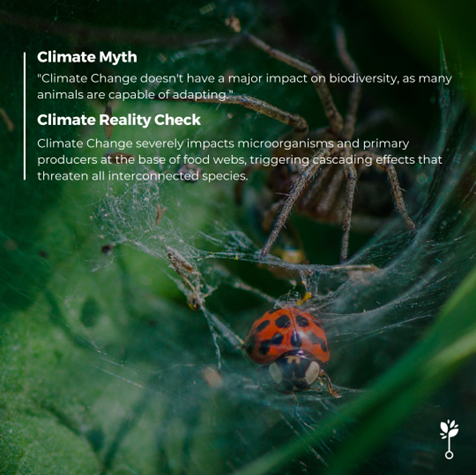
Climate change isn’t just about warmer temperatures; it’s a profound disruption to Earth’s intricate systems, and perhaps nowhere is this more evident than in its impact on biodiversity and the delicate balance of food chains[1]. Imagine a complex Jenga tower: each block represents a species, from microscopic organisms to apex predators. Climate change is the unseen hand relentlessly pulling at those blocks, threatening to collapse the entire structure.
How Climate Change disrupts the food chain’s foundation
The “food chain” is a simplified concept; in reality, ecosystems operate on food webs, where species are interconnected in a much more complex network of predator-prey relationships. Climate change impacts this web at every level:
- Temperature shifts: Organisms have evolved to thrive within specific temperature ranges. As global temperatures rise, species are forced to adapt, migrate, or face extinction. This can lead to trophic mismatches, where the timing of a predator’s reproduction or migration no longer aligns with the peak availability of its prey[2]. For example, birds may arrive at breeding grounds only to find their insect food source has already bloomed and declined due to earlier springs[3].
- Changes in precipitation and extreme weather: Droughts, floods, and more intense storms alter habitats and directly impact the growth of plants, the availability of water, and the survival of species. This affects primary producers (plants, algae)[4], which form the base of almost all food webs.
- Ocean acidification: As oceans absorb excess carbon dioxide from the atmosphere, they become more acidic. This poses a severe threat to marine organisms, especially those with shells or skeletons made of calcium carbonate, like corals and shellfish[5]. This directly affects the base of marine food webs.
- Habitat loss and shifting ranges: As climate change, the geographical ranges of many species shift. This can lead to competition with native species, introduce new diseases, and fragment existing habitats, making it harder for species to find food and reproduce[6].
- Altered nutrient cycles: In some ecosystems, particularly the Arctic, warming temperatures are melting permafrost, leading to changes in the soil microbiome. This can shift food webs from “green” (plant-based) to “brown” (microbe-based)[7], with uncertain consequences for the entire ecosystem.
Species and microorganisms most at risk
The most vulnerable species in the food chain are often those at the base or those with highly specialized diets or limited mobility. Changes at the lower trophic levels cascade upwards, affecting every organism above them[8].
The unseen heroes: Microorganisms
While often overlooked, microorganisms are foundational to almost every ecosystem and food web. They are critically endangered in several ways:
Marine phytoplankton: These microscopic plants are responsible for roughly half of the Earth’s photosynthesis and form the base of the entire marine food web[9]. Warmer ocean temperatures and ocean acidification directly threaten their growth rates and survival, which could collapse marine ecosystems.
Soil microbes (Fungi, Bacteria): On land, climate change impacts soil microbiomes. Warming temperatures and altered precipitation patterns can reduce the diversity and function of beneficial soil bacteria and fungi (like Firmicutes), which are essential for nutrient cycling, carbon sequestration, and supporting plant growth. Changes here directly affect primary producers[10].
Pathogenic microbes: Conversely, climate change can also promote the spread of certain pathogenic microorganisms. Warmer, wetter conditions can favor the growth and distribution of bacteria like Vibrio[11] (which contaminates shellfish) and increases the range of disease-carrying vectors like mosquitoes and ticks[12], leading to increased disease outbreaks in both wildlife and humans.
Vulnerable species across the food web:
Primary producers (Plants & Algae):
- Corals: Highly sensitive to ocean temperature increases and acidification, leading to mass bleaching events. Their decline impacts countless species that rely on reefs for food and shelter.
- Specific crop plants: Many staple crops (e.g., wheat, rice, corn) are sensitive to extreme temperatures and altered precipitation, impacting food security for humans and livestock[13].
- Arctic algae (e.g., those forming “brown food webs”): Shifts in dominant algal types or their abundance due to permafrost melt can alter the entire Arctic food web[14].
Herbivores and filter feeders (primary consumers):
- Krill: These tiny crustaceans are a keystone species in the Antarctic, feeding on ice algae. As sea ice melts, krill populations decline, severely impacting whales, penguins, and seals that depend on them[15].
- Mollusks (e.g., mussels, oysters, pteropods): Ocean acidification directly hinders their ability to build shells, making them more vulnerable to predators and environmental stress.
- Bumblebees: Critical pollinators, bumblebee populations are being decimated by heatwaves and shifting flowering times[16], leading to reduced plant reproduction and, subsequently, less food for animals higher up the chain.
- Arctic small mammals (e.g., shrews, voles): Their diets are shifting from plant-based to fungal, indicating fundamental changes in the lower parts of the Arctic food web[17].
Carnivores and omnivores (higher trophic levels):
- Arctic predators (e.g., Polar Bears, Adélie Penguins): Directly impacted by the decline of their primary food sources (seals, krill) due to sea ice melt[18].
- Fish (e.g., Pacific Cod, Chinook Salmon): Warmer waters affect their metabolism, migration patterns, and susceptibility to disease and parasites, leading to population declines. Mass die-offs of common murres (sea birds) have been linked to altered marine food webs caused by heatwaves, leading to starvation[19].
The Domino effect
The interconnectedness of food webs means that even seemingly small changes at one level can have cascading effects throughout the entire ecosystem. The loss or decline of a single species can weaken the entire web, making it more susceptible to further disturbances. Understanding these relationships is crucial, as the stability of natural ecosystems directly underpins the resources vital for human survival, from food to clean air and water. Protecting biodiversity is not just about saving charismatic megafauna; it’s about safeguarding the fundamental processes that keep our planet habitable.
[1] https://pmc.ncbi.nlm.nih.gov/articles/PMC9058818/
[2] https://www.sciencedirect.com/science/article/am/pii/S2214574516301286
[3] https://19january2017snapshot.epa.gov/climate-impacts/climate-impacts-ecosystems_.html
[4] https://www.ceh.ac.uk/news-and-media/blogs/impacts-drought-water-quality-and-wildlife
[5] https://oceanservice.noaa.gov/education/tutorial_corals/coral08_climatechange.html
[6] https://www.sciencedirect.com/science/article/pii/S2542519624000214
[7] https://www.researchgate.net/figure/Conceptual-model-of-green-brown-food-web-coupling-and-the-impact-on-trophic-structure_fig1_366178057
[8] https://www.ebsco.com/research-starters/science/trophic-cascade
[9] https://svs.gsfc.nasa.gov/10497/
[10] https://www.sciencedirect.com/science/article/pii/S2949919425000032#:~:text=Key%20findings%20reveal%20that%20climate%2Dinduced%20disruptions%20such,increased%20greenhouse%20gas%20emissions%2C%20amplify%20these%20effects.
[11] https://www.efsa.europa.eu/en/news/vibrio-bacteria-seafood-increased-risk-due-climate-change-and-antimicrobial-resistance
[12] https://pmc.ncbi.nlm.nih.gov/articles/PMC6378404/
[13] https://www.carbonbrief.org/high-temperatures-hit-staple-crops-us-century-study-says/
[14] https://bg.copernicus.org/articles/12/7129/2015/bg-12-7129-2015.pdf
[15] https://www.asoc.org/campaign/conserving-antarctic-krill/
[16] https://pmc.ncbi.nlm.nih.gov/articles/PMC10644220/
[17] https://arctic.noaa.gov/report-card/report-card-2016/shrews-and-their-parasites-small-species-indicate-big-changes/
[18] https://www.wwf.org.uk/updates/11-arctic-species-affected-climate-change
[19] https://www.researchgate.net/publication/386988554_Catastrophic_and_persistent_loss_of_common_murres_after_a_marine_heatwave
Other News