
December 8, 2025
What is the Gulf Stream and its ‘Conveyor Belt’?
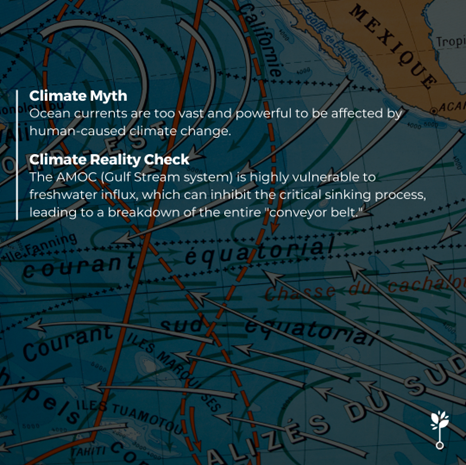
One of the most concerning climate myths today is the idea that global heating and the massive currents of the Gulf Stream are unrelated. This is false. Far from being separate, climate change is actively destabilizing the Gulf Stream system, threatening to bring about severe and unpredictable climate shifts worldwide.
In fact, the system responsible for the Gulf Stream is now at its weakest point in over a millennium, leading scientists to warn that a critical tipping point[1], a complete collapse, could occur much sooner than previously thought, potentially as early as 2025 if global emissions are not rapidly cut.
What is the Gulf Stream and its ‘Conveyor Belt’?
The Gulf Stream is a fast, warm ocean current that carries tropical water from the Gulf of Mexico up along the eastern coast of North America and across the Atlantic, where it splits to warm the western coasts of Europe.
This current is just one part of a much larger global circulation system called the Atlantic Meridional Overturning Circulation (AMOC). Think of the AMOC as a giant, crucial ocean conveyor belt[2].
- The northward flow: Warm, salty water travels north near the surface, bringing mild temperatures to Europe[3].
- The overturning: Near Greenland, this water cools significantly. Because it is also very salty (and therefore dense), the cold water becomes incredibly heavy and sinks deep into the ocean[4].
- The southward flow: This dense, deep, cold water then travels back south along the ocean floor, completing the circuit and driving the entire current system[5].
It is this constant circulation that has historically kept Northwestern Europe’s climate surprisingly mild for its latitude.
The connection: How Climate Change stops the engine
The key to the AMOC’s function is the density of the northern water – it must be salty enough and cold enough to sink[6]. Climate change directly interferes with this process in a crucial way:
- The melting ice and freshwater flood: Global heating is causing the massive Greenland ice sheet to melt at an accelerated rate. This meltwater – which is fresh, not salty – pours into the North Atlantic Ocean[7]. Increased rainfall in the region also contributes to this influx.
- The water gets too light: When this enormous volume of freshwater mixes with the salty surface water near Greenland, it makes the overall water less salty[8], or fresher. Fresher water is inherently less dense (lighter) than salty water.
- The sinking stops: Because the water is now too light, it is less able to sink into the deep ocean and drive the conveyor belt. It essentially smothers the system. This is why climate change is causing the entire AMOC, and thus the Gulf Stream, to weaken.
Catastrophic consequences for Europe and the world
The weakening of the AMOC is not just an academic concern; it is a serious threat with far-reaching consequences:
Paradoxical cooling in Europe
While the rest of the world continues to warm, Northwestern Europe would become the anomaly. Without the warm ocean current acting as a massive heat pump, winters could become drastically colder. Studies suggest that under certain scenarios, cold extremes in places like the Netherlands could plunge by as much as 15 degrees Celsius compared to pre-industrial norms[9].
Accelerated sea level rise
A weakened current means that water piles up along the Atlantic coast instead of flowing away. This would lead to an accelerated rise in sea levels along the eastern coast of North America[10] and Europe’s Atlantic shores, adding meters to current projections for coastal regions like the Netherlands.
[1]https://www.theguardian.com/environment/2025/aug/28/collapse-critical-atlantic-current-amoc-no-longer-low-likelihood-study
[2] https://oceanservice.noaa.gov/facts/amoc.html
[3]https://www.theguardian.com/environment/2021/feb/25/atlantic-ocean-circulation-at-weakest-in-a-millennium-say-scientists
[4] https://education.nationalgeographic.org/resource/ocean-conveyor-belt/
[5] https://physicstoday.aip.org/features/upwelling-in-the-southern-ocean
[6]https://medium.com/the-new-climate/the-atlantic-meridional-overturning-circulation-amoc-s-missing-puzzle-piece-63665f73b0d3
[7]https://www.preventionweb.net/news/meltwater-greenland-and-arctic-weakening-ocean-circulation-speeding-warming-down-south
[8] https://agupubs.onlinelibrary.wiley.com/doi/full/10.1029/2018JC014686
[9] https://www.uu.nl/en/publication/what-will-happen-to-europe-if-the-gulf-stream-weakens-significantly
[10]https://www.newscientist.com/article/2480435-us-east-coast-faces-rising-seas-as-crucial-atlantic-current-slows/
Other News